The brief
We wanted the site to offer a place to play, with no installation or account setup. Odyssey became the larger experiment: make a world that is enjoyable to drive through, then give the player a reason to explore it and something to return to.
What we built
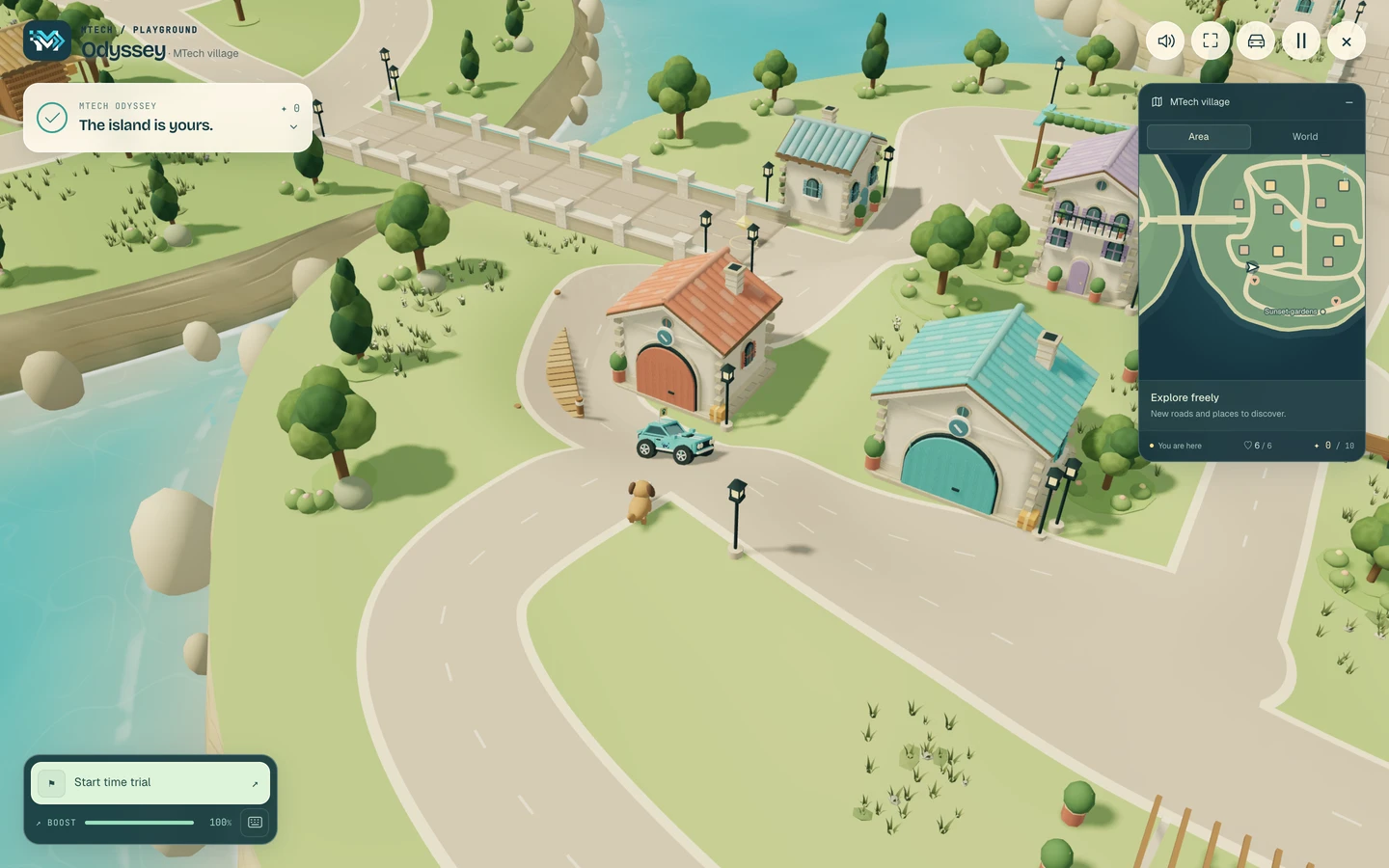
- Odyssey: island roads, parcel deliveries, bridge construction, unlocks and a garage of vehicles with different driving behavior.
- Keyboard driving and touch controls, with directional steering, drift and an unlockable boost mechanic supported by a compact driving HUD.
- A coastal world with villages, woodland, a harbor, a lighthouse, wildlife and environmental detail.
- Local progress saves, plus the shorter Portal Run and Fragments games in a shared English/Romanian library.
Keeping the world and the rules in step
Odyssey separates world and progression rules from rendering, movement, input and interface code. Delivery rewards, construction requirements and unlocks can be checked independently of the scene, while browser journeys exercise the actual path through the game.
The driving work connects road and terrain contact with steering, the camera and touch input. The HUD gives nearby actions and driving feedback their own space, so the screen can support both exploration and a delivery objective on smaller displays.
Stack
Next.js and React for the library and game interface, Three.js for the 3D worlds, Web Audio for sound, browser storage for progress, and Node and Playwright for rules and journey checks.
Where it stands
Playable in-house games that continue to evolve. Odyssey is single-player and saves to the current browser; progress does not sync between devices and is removed when browser data is cleared.